Bordeaux En Primeur 2025: Freshness, Precision and Rarity
Freshness, Precision and Rarity
The 2025 Bordeaux En Primeur campaign is shaping up to be particularly compelling for discerning collectors. As each year, it offers a snapshot of a vintage still in the making. In 2025, that snapshot reveals an early and technically demanding growing season, defined by historically low yields and a style of wine firmly oriented towards precision and balance.
In this context, several factors stand out for both fine wine enthusiasts and those considering an investment: relative scarcity, alignment with current market preferences, and the potential to fit within a medium- to long-term patrimonial approach.
Bordeaux En Primeur 2025: a style defined by freshness and drinkability
The 2025 vintage stands out for a stylistic profile that is particularly sought-after today: finesse, freshness and drinkability.
Moderate alcohol content
In contrast to some recent solar vintages, Bordeaux 2025 En Primeur wines display more restrained alcohol levels. On average, they are around one degree lower than those observed in the warmest vintages, enhancing both elegance and drinkability. This balance is increasingly valued by consumers.
Fresh, finely structured reds
The red wines of the 2025 Bordeaux vintage offer a precise expression of fruit—fresh cherry, blackcurrant and raspberry—supported by present yet polished tannins. The structure is refined, the palate shows a fine sense of tension, and the overall balance is harmonious.
These are wines of architecture and precision, with strong ageing potential for the leading estates of the Médoc, the Right Bank and Pessac-Léognan. For certain properties, approachability may come earlier than in vintages such as 2018 or 2022, while still retaining a solid tannic backbone.
Bright, finely tuned whites
Dry whites, particularly from Pessac-Léognan, are among the highlights of the 2025 vintage. Their tension, aromatic brightness and precision on the palate make them especially compelling from both a qualitative and strategic perspective.
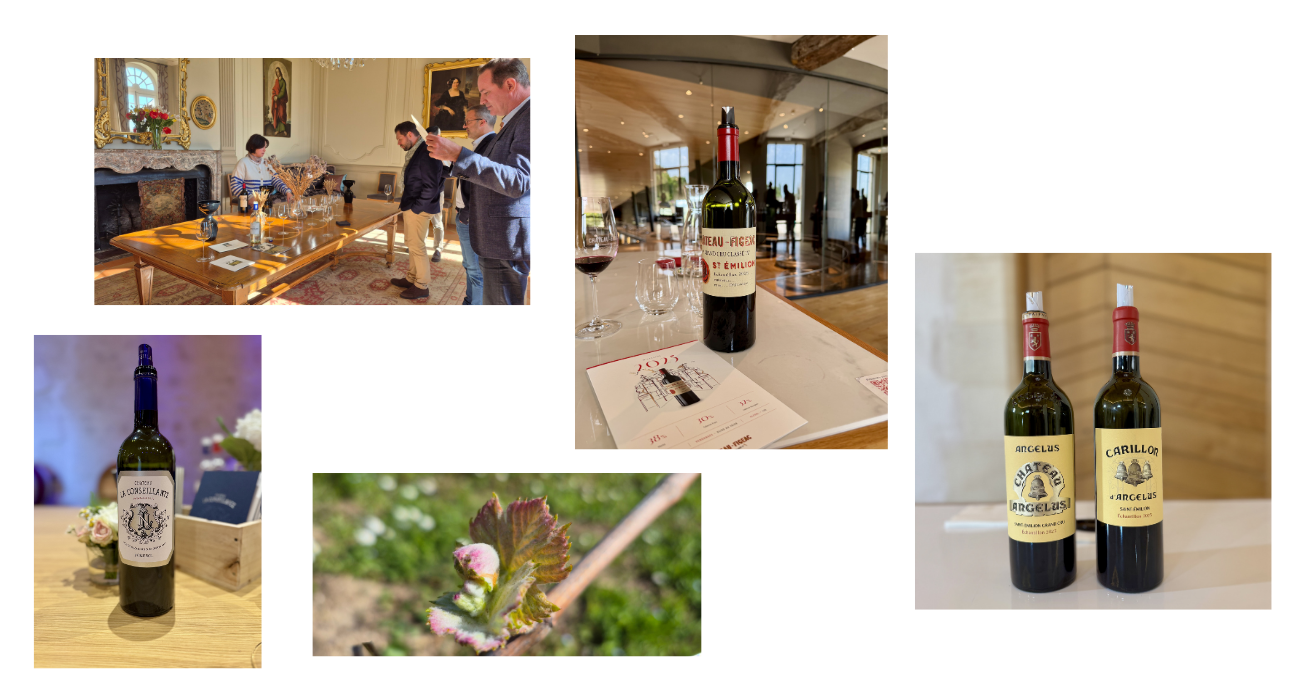
From left to right, top to bottom: Château Laroque, Château La Conseillante, Château Figeac, vines of Château Beau-Séjour Bécot, Château Angélus.
Why buy Bordeaux En Primeur 2025?
Beyond the intrinsic appeal of discovering a new vintage, the 2025 En Primeur campaign presents several compelling arguments for buyers.
Lower volumes: a rare opportunity
One of the defining features of the Bordeaux En Primeur 2025 campaign is the limited production. The harvest is the smallest since 1991. In several leading appellations—Margaux, Saint-Julien, Pauillac and Pomerol—yields are significantly below the ten-year average.
Average vineyard yields by appellation (hl/ha)
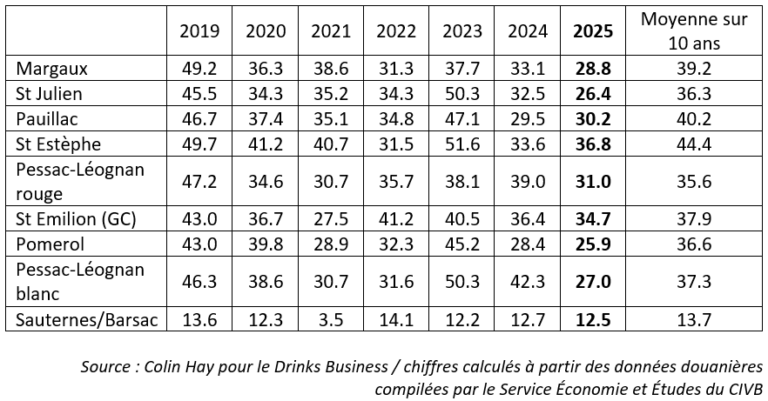
This decline is primarily the result of the pronounced hydric stress during the summer of 2025, which naturally reduced yields by encouraging the formation of very small berries. This reduction in berry size, combined with thick skins and a high skin-to-juice ratio, contributed to the concentration observed in the wines while simultaneously reducing overall volumes. It also finds part of its origin in the previous growing cycle: in certain estates, flowering conditions in 2024 impacted bud fertility and thus the yield potential for 2025. These factors were compounded by deliberate quality-driven decisions at château level, with rigorous parcel selection and a clear preference for concentration over quantity. Taken together, they have resulted in materially lower volumes released onto the market.
This structural scarcity inherently supports tension on allocations, particularly for the most sought-after names. In a Bordeaux fine wine market where selectivity has become paramount, securing positions during the En Primeur campaign allows buyers to anticipate potential supply constraints on the secondary market.
A style aligned with current demand
The market is clearly moving towards wines that are fresher, lower in alcohol and more digestible. The 2025 vintage fits squarely within this broader structural shift.
Buying En Primeur: a strategic advantage
Today, an En Primeur strategy must be approached with discernment. The 2025 vintage offers genuine interest, provided one focuses on estates that demonstrate pricing discipline and on appellations where reduced volumes are creating tangible pressure on supply.
From an intrinsic standpoint, 2025 brings together several elements conducive to a selective investment approach: a style aligned with contemporary preferences—greater freshness, moderated alcohol levels and precise aromatic expression—alongside notable phenolic concentration, driven by small berry size and thick skins. That said, ageing potential will not be uniform; it will depend closely on the balance achieved within each terroir, particularly the interplay between tannic structure, acidity levels and pH management. Estates that have preserved this structural harmony are likely to produce wines capable of evolving with consistency and depth.
Securing allocations during the En Primeur campaign, especially for wines produced in historically low volumes, therefore allows buyers not only to retain access to key signatures, but also to manage their entry point in a market where disciplined supply may continue to underpin allocation pressure over time.
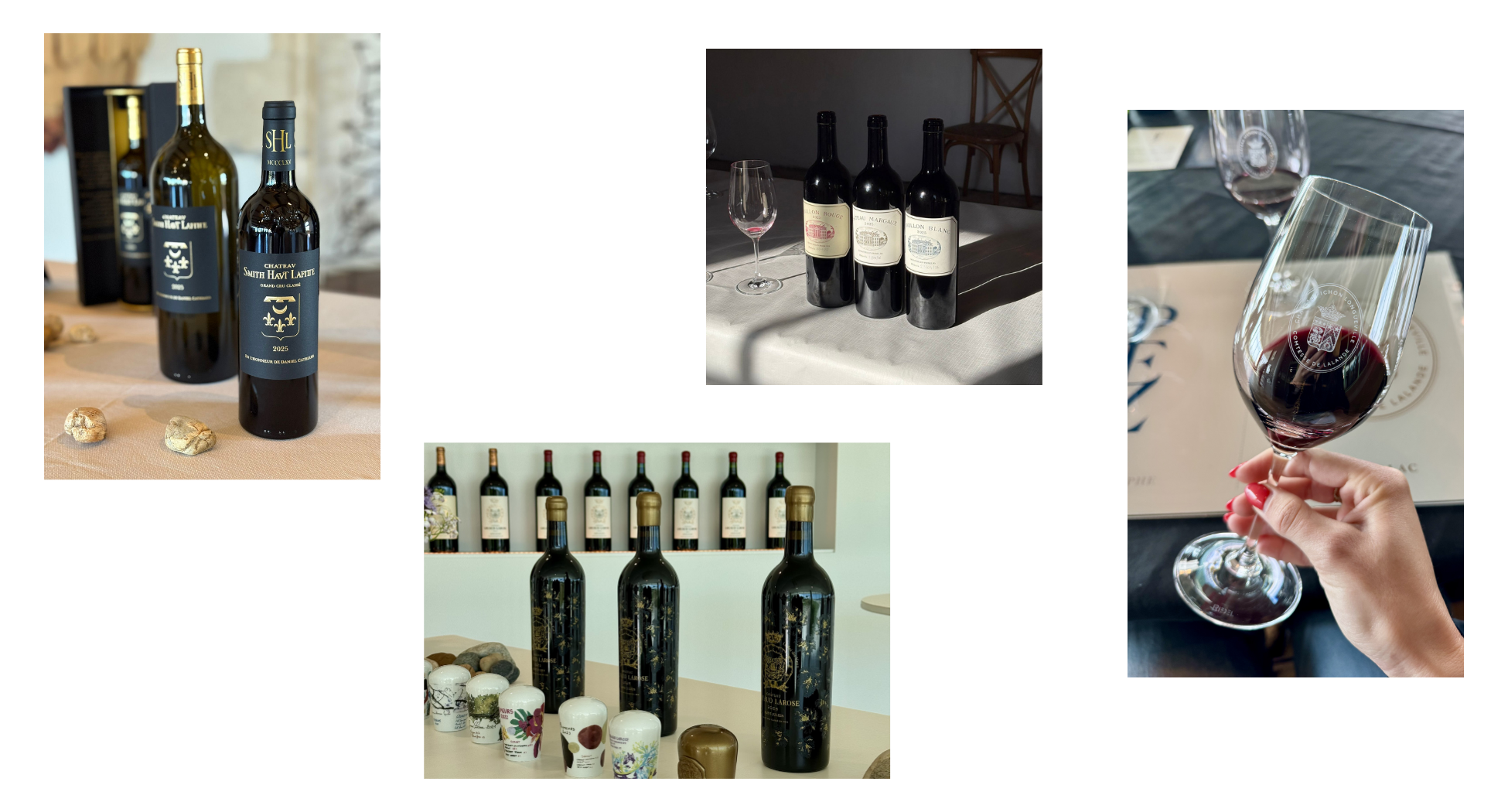
From left to right, top to bottom: Château Smith Haut Lafitte, Château Gruaud Larose, Château Margaux, Château Pichon Longueville Comtesse de Lalande.